Welcome to our new website!

We welcome your feedback on our blogs!  Drop us a line and let us know what you think.


Feb. 16, 2026

Why More Buyers Are Choosing New Construction

Is It Time for a Fresh Start? 

At some point, the home that once felt perfect just… doesn’t anymore.

Maybe you need more space.
Maybe your dining room has permanently turned into a home office.
Maybe the layout simply doesn’t match how you live today.

If your current home feels like it’s holding you back instead of supporting your lifestyle, you’re not alone. And if you’re thinking about selling, the next big question becomes: Where do you go from here?

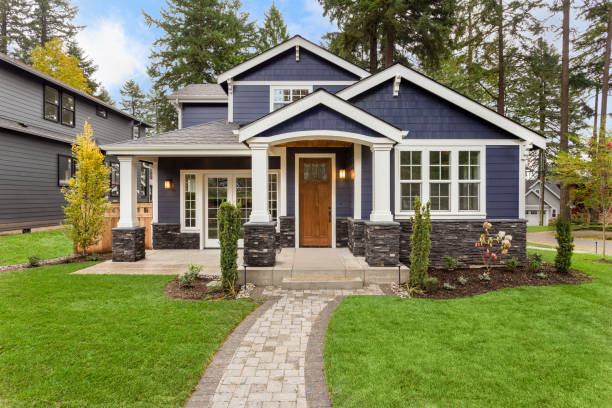
For a growing number of buyers, the answer is simple — new construction.


New Construction Is on the Rise

According to the National Association of Realtors, 16% of recently purchased homes were newly built — the highest percentage in nearly two decades.

That’s a big shift.

More buyers, especially move-up buyers, are seriously considering brand-new homes instead of existing ones. And it’s not just about shiny finishes — it’s about lifestyle, convenience, and peace of mind.


Why Buyers Are Making the Move to Brand-New Homes

1. Everything Is Brand New

No mystery roof age.
No HVAC surprises.
No inherited DIY projects.

When you’ve spent years updating and maintaining your current home, the idea of starting fresh — with everything under warranty — can feel like a major relief.


2. Personalization Before You Move In

If you purchase a home that’s still under construction, you may get the opportunity to choose:

  • Flooring

  • Countertops

  • Cabinets

  • Lighting

  • Fixtures and finishes

Instead of remodeling later, you can design it right from the start.


3. Designed for How We Live Today

New construction homes are built with modern living in mind. That often means:

  • Open floor plans

  • Dedicated office space

  • Smart home technology

  • Energy-efficient systems (which can help lower utility bills)

If your current layout just isn’t working anymore, a newer home might already have exactly what you’ve been wishing for.


4. Built-In Community Amenities

Many new developments offer shared spaces like:

  • Walking trails

  • Parks and playgrounds

  • Pools

  • Fitness centers

For active households or families, having those amenities just steps away can be a huge bonus.


5. Builder Incentives

With more new homes on the market right now, builders are motivated to sell. That can mean:

  • Negotiation on price

  • Closing cost assistance

  • Upgrade incentives

  • Rate buy-down options

In today’s market, that flexibility can make new construction even more appealing.


The Bottom Line

If your current home no longer fits your needs, don’t assume your only option is another resale property.

New construction is becoming a strong contender — especially for move-up buyers who want more space, modern features, and a home that truly works for how they live today.


If you’re curious whether building new might be the right move for you, let’s talk through your options and see what makes the most sense for your next chapter.
Feb. 11, 2026

Advice for Buying or Selling a Home in 2026

Mortgage rates are expected to decline somewhat over the next several quarters, which has implications for prospective homebuyers and sellers. But regardless of current mortgage rate trends, Americans will still have reasons to move, whether they want to downsize in retirement or need to relocate for a better job.

Here's what you should consider if you're planning on buying or selling a home in 2026.

What Buyers Should Know: Waiting for Lower Rates Comes at a Price

Good things may come to those who wait, but patience doesn't always pay off in the housing market. Four in five homebuyers are waiting for mortgage rates to fall this year before buying a home, according to a March 2025 U.S. News survey. A quarter of them (25%) want to see rates below 5% before entering the market, which isn't expected to happen in the near future.

In the time that homebuyers have been holding out for lower rates, home values have continued to rise. Home prices have appreciated by about 16% since the beginning of 2022, according to the S&P CoreLogic Case-Shiller Home Price Index – despite mortgage rates doubling in that time frame.

Housing price increases have slowed, but buyers shouldn't expect prices to come crashing down, at least not on a national level. Here are a few home price forecasts from top U.S. housing groups:

  • Fannie Mae: Home prices will rise 2.4% in 2026 and 2.2% in 2027.
  • MBA: Home prices will increase by 0.6% in 2026 and increase by 0.5% in 2027.
  • NAR: The median home price will rise by 4% in 2026.
  • Realtor.com: Existing home sales prices will increase by 2.2% in 2026.

Although home values aren't likely to drop, it's still positive that they probably won't keep rising at the double-digit pace seen in 2021 and 2022. Without over-the-top bidding wars to drive home prices through the roof, buyers can expect more properties to choose from.  

Buyers may also be able to close the deal without waiving important protections, such as home inspections and appraisal contingencies. What's more, existing home inventory is forecast to improve – at least marginally – as rates drift lower and some previously rate-locked homeowners decide to sell.

Finally, buyers may find less competition in the new home construction market. Homeowners may be reluctant to sell and risk losing their low mortgage rates, but homebuilders remain eager to close the deal, especially as new home inventory rises. Although new construction homes are typically more expensive than resale homes, builders may be willing to offer other concessions, such as price reductions or temporary interest-rate buydowns.

What Sellers Should Know: Remember That You're a Buyer, Too

Perhaps the biggest hurdle facing sellers is finding a place to live once they've sold their current home. For many, that means overcoming the lock-in gap to buy a new home at today's rates and home prices.

According to the Federal Housing Finance Agency, the average interest rate on existing mortgages is 4.4% – far lower than the current prevailing rate available to new homebuyers. In fact, more than three-quarters of homeowners have a rate below 6%, and rates aren't expected to dip below that threshold anytime within the next few years.

Although many prospective sellers would be hard-pressed to give up their sub-3% mortgage rate, experts predict that the rate lock-in effect will eventually wear off somewhat as homeowners grow tired of waiting.
Plus, a 2023 Fannie Mae survey suggests that low rates aren't the only factor keeping people from selling. While a fifth of mortgage borrowers (21%) say their low mortgage rate is causing them to stay in their home longer, nearly as many said they simply like their current home (19%). Perhaps unsurprisingly, 13% say they're staying put because home prices are too high.

However, there is a silver lining for sellers who are also buyers: Many homeowners are sitting on a mountain of equity thanks to double-digit home price appreciation since 2020. Successful sellers can tap into that equity to put toward their next home purchase.

Want more details? Read more about the 2026 mortgage rate forecast HERE.


Feb. 6, 2026

It’s Getting More Affordable To Buy a Home

There’s finally a little good news for anyone who’s been priced out or sitting on the sidelines.

Buying a home is getting more affordable.

Monthly payments have started to come down, and the squeeze buyers have been feeling for the past few years is slowly loosening. Now, that doesn’t mean everyone can suddenly afford a home, but with how tough the market’s been, the improvement we’re seeing matters.

Affordability Is Finally Moving in the Right Direction

One of the best ways to see this shift is by looking at how much of a household’s income it takes to buy a home.

According to Zillow, housing is typically considered affordable when it takes 30% or less of your monthly income to cover your expenses. That includes your mortgage payment, taxes, insurance, and basic maintenance.

For the past few years, the math was well above that threshold, and it made buying a home unachievable for many. But now, we’re slowly moving back toward a balance. Zillow research shows it’s taking less of a typical household’s income to buy a home than it did just a few years ago

Now, we’re not all the way back to Zillow’s threshold of 30% of your income or less, so affordability is still tight. But things are trending in the right direction.

Why Affordability Is Improving

So, what’s driving the change? A lot of the focus lately has been on mortgage rates and how much they’ve come down over the course of the past year. But that’s not the only factor working in favor of buyers right now. Here are three trends benefiting buyers today: 


1. Mortgage rates have eased. Rates are near their lowest level in more than three years, which helps lower monthly payments.

2. Home price growth has cooled. Prices aren’t falling nationally, but they’re growing much more slowly than they were a few years ago. That means buyers today aren’t facing the same sharp jumps in purchase prices, which helps keep monthly payments more manageable – and buying more predictable. 

3. Wages are growing faster than home prices. This one matters a lot. As Mark Fleming, Chief Economist at First American, explains:

“When income growth exceeds house price growth, house-buying power improves—even if mortgage rates don’t decline meaningfully.”

None of this makes buying cheap, but it does explain why the math is starting to work a little better for buyers than it did even a just a year ago. Put simply, the forces that hurt affordability over the past few years are finally easing. Fleming again explains it well:

“Affordability remains challenging, but for the first time in several years, the underlying forces are finally aligned toward gradual improvement. Mortgage rates may drift down only slowly, but income growth exceeding house price appreciation will provide a boost to house-buying power — even in a higher-rate world. Affordability won’t snap back overnight, but like a ship finally catching a steady tailwind, it’s now sailing in the right direction.”

These three factors combined are why economists expect affordability to keep improving in 2026.

Where Homes Are Becoming Affordable First

But how much is affordability really going to improve? In some places, noticeably. Zillow says some markets are expected to fall back under their affordability threshold (30% of your income or less) by the end of the year:

But that doesn’t mean you have to be in one of these markets or wait until year-end to buy. Other places are already seeing big improvements in affordability. So, talk to a local agent about what’s happening in your market. You may find you’re able to buy after all.

Bottom Line

For the first time in quite a while, affordability is easing. That’s a meaningful shift.

And because this improvement isn’t happening everywhere at the same speed, understanding what’s changing locally is what really makes a difference. If you want to see how these trends show up in our area, let’s talk it through.

Feb. 5, 2026

8 Tips for Selling Your Home in Winter


The months of December through February see less robust real estate activity in many areas due to the holidays and the cold weather, according to the National Association of REALTORS®. But if you need to sell your home during winter, you can capitalize on certain advantages that seasonal selling provides. For one thing, winter buyers are typically motivated, whether it’s due to a work relocation, expanding family or other pressing need. And because there are generally fewer homes on the market during this time, sellers can benefit from less competition when negotiating offers.

Here are ways to maximize the appeal of your home during the winter:

  1. Focus on curb appeal. Clean up fallen leaves and dead branches. Make the front door inviting with planted topiaries, a festive door wreath and a fresh welcome mat.
  2. Make the exterior safe. If you’re in an area with ice and snow, clear the driveway and walking paths. Spread rock salt or sand to prevent slips and falls.
  3. Spruce up the interior. Declutter and clean all the rooms. Then, add warmth with fuzzy throw pillows and blankets. If you have a fireplace, fire it up for open houses—but never when the home is unattended for any period. Set your dining table as if you’re hosting a holiday get-together.
  4. Add potted indoor plants. Flowering plants or an indoor herb garden can add additional warmth and liven up the interior of your home.
  5. Light it up. Clean windows to allow more natural light to shine through. Replace burned out lightbulbs, add standing lamps to darker spaces, and turn on all the lights for showings to ensure the home is bright and cheerful.
  6. Warm it up. Keep the temperature at a comfortable level for showings. Turning down the thermostat will make your home feel cold and uninviting.
  7. Accommodate showing requests. Allowing showings during the holiday season can be difficult, but the answer to showing requests should almost always be yes. Don’t miss out on showing your beautiful home to motivated buyers.
  8. Pay attention to the senses. Buyers may be sensitive to strong perfumes and scented candles. Opt first for a “clean” smell, and then consider adding a touch of vanilla, citrus or cinnamon.

These adjustments can yield a quicker sale with a greater net during winter months.

Bonus Tip: Should holiday decorations come down? Some decorations can add a festive mood to your home. But avoid going overboard. If you have a Christmas tree, consider removing ornaments that are too personal. Save them to put up next year in your new home.

See the full article by the National Association of Realtors HERE.

Jan. 29, 2026

ADU's - A Step Toward Inclusive Housing?

Asheville Eases Rules for Accessory Dwelling Units: A Step Toward Inclusive Housing?

Accessory dwelling units — small, secondary homes on the same lot as a primary house — have become a topic of interest in communities across the country looking for creative ways to ease housing shortages. On January 27, 2026, the Asheville City Council unanimously voted to relax some rules around ADUs, making it easier for homeowners to convert existing structures into livable space.

What’s Changing?

Under the new policy, homeowners in Asheville can now convert pre-existing accessory structures — like detached garages, sheds, or pool houses built before current zoning regulations — into independent dwelling units without first seeking approval from the city’s Board of Adjustment. Previously, those owners had to go through a variance process if a building didn’t meet strict zoning distance requirements.

The goal of this change is straightforward: reduce time, cost, and uncertainty so that more housing options can be created more efficiently. While Asheville’s ADU regulations still enforce limits on unit size and parking, the automatic approval for conversions removes a procedural hurdle that has slowed or discouraged some homeowners.

Rules Still Matter

Even with this simplification, ADUs must comply with existing city standards around:

  • Size: Up to 800 square feet on lots less than one acre; up to 1,200 square feet on lots between one and three acres.

  • Parking and height requirements: Still in effect and monitored by the city’s planning department.

  • Use restrictions: Units created under this new rule cannot operate as short-term vacation rentals or homestays — they must serve as long-term dwelling spaces.

These conditions reflect Asheville’s broader zoning framework, which allows one ADU per single-family lot while seeking to manage neighborhood scale and infrastructure impacts.

What This Means for Asheville

To many housing advocates, simplifying the ADU process is a positive step. ADUs — sometimes called “granny flats,” “in-law suites,” or “carriage houses” — can:

  • Expand housing options in established neighborhoods without large developments.

  • Offer homeowners supplemental income through long-term rentals.

  • Provide more affordable, flexible living spaces for seniors, students, and small households.

Yet the changes are not without community concerns. Discussions leading up to the vote noted anxieties among residents — especially in historically underserved areas — about predatory investment and displacement. People in legacy neighborhoods like Emma, Shiloh, and Burton Street raised the alarm that outside investors might use easier ADU construction as a way to profit and accelerate gentrification pressures.

Local groups like the Legacy Neighborhoods Coalition did not oppose the rule change outright but urged the city to pair zoning flexibility with anti-displacement strategies that protect community character. Ideas like “legacy neighborhood preservation districts” were proposed as one possible approach to managing that balance.

A Broader Housing Puzzle

This update is just one piece of Asheville’s ongoing housing policy conversation. The city has been exploring a range of tools — from density reforms to affordable housing funding — to respond to rising costs, limited supply, and community equity concerns. ADUs are one of the more accessible bottom-up strategies, letting homeowners take part in housing production without large scale construction or new subdivisions.

Final Thoughts

For homeowners and neighbors alike, the ADU rule change simplifies a specific part of Asheville’s zoning code and potentially opens the door for more creative housing in our community. The real test will be how many of these converted units actually get built — and whether accompanying policies can ensure that increased housing options benefit existing residents rather than displacing them.


As Asheville continues to tackle housing challenges, this decision reflects a broader shift toward flexibility — but also highlights the need for intentional strategies that protect neighborhood stability and inclusiveness.


See full article HERE from BPR!

Posted in Good to know info
Jan. 22, 2026

Key Tax Deductions for Homeowners

🏡 Keep More When You Sell: Key Tax Deductions for Homeowners

Selling a home can be both emotionally rewarding and financially impactful—but Uncle Sam gets a say, too. The good news? Many of the taxes tied to selling your house don’t have to take as big a bite out of your profit as you might think. Realtor.com breaks down several deductions and exclusions that can help lower your tax bill when you sell your principal residence.

1. Selling Costs: Deduct What You Spend to Sell

When you sell your home, many of the costs directly tied to the sale can reduce your taxable gain. These include:

  • Real estate agent commissions

  • Legal fees and title charges

  • Escrow fees and closing costs

  • Advertising and staging expenses

Instead of a standard deduction, these costs are subtracted from your home’s sales price when calculating your capital gain—meaning a lower tax burden when selling your principal residence.

2. Home Improvements and Repairs

Did you spruce up the house to make it more marketable before selling? Many of those expenses might help you:

  • If improvements were essential to selling (like fresh paint, roof repair, or replacing a water heater) and done within 90 days of closing, they can be counted as selling costs.

  • These can reduce your taxable gain by increasing your cost basis or by reducing the taxable sale amount.

Track every receipt! The IRS looks closely at documentation when you add improvements to your home’s basis.

3. Property Taxes Aren’t Forgotten

If you paid property taxes up to the sale, you can generally deduct the amount you paid the year of the sale—up to a $10,000 cap (this cap is shared with other state/local tax deductions).

4. Mortgage Interest May Still Help

Even in the year you sell, you can itemize and deduct the mortgage interest you’ve paid—up to the IRS cap (generally $750,000 in mortgage debt for most newer mortgages).

However, this only helps if your total itemized deductions exceed the standard deduction—which has been significantly higher since tax reform in 2018.

5. Capital Gains Exclusion: The Big Break

Instead of a deduction, this is a major tax exemption many sellers rely on:

  • Single homeowners can exclude up to $250,000 of profit

  • Married couples filing jointly can exclude up to $500,000

To qualify, you must have lived in the home as your principal residence for at least two of the five years before the sale.

💡 What counts as “profit”? It’s the amount left after subtracting your cost basis (what you paid plus improvements and selling costs) from your sales price. Increasing your cost basis—by tracking upgrades—lowers your taxable gain, helping you stay within that exclusion limit.

Final Thoughts: Keep Records and Plan Ahead

Tax rules change, and the IRS looks at documentation closely. Whether it’s receipts for renovations, settlement statements, or agent invoices, keeping good records makes claiming these deductions and exclusions much easier.


Before filing, it’s smart to consult a tax professional—especially if your sale edge cases (like short ownership spans or rental use) might affect eligibility. 

Posted in Good to know info
Sept. 16, 2025

August 2025 Market Stats for Buncombe County

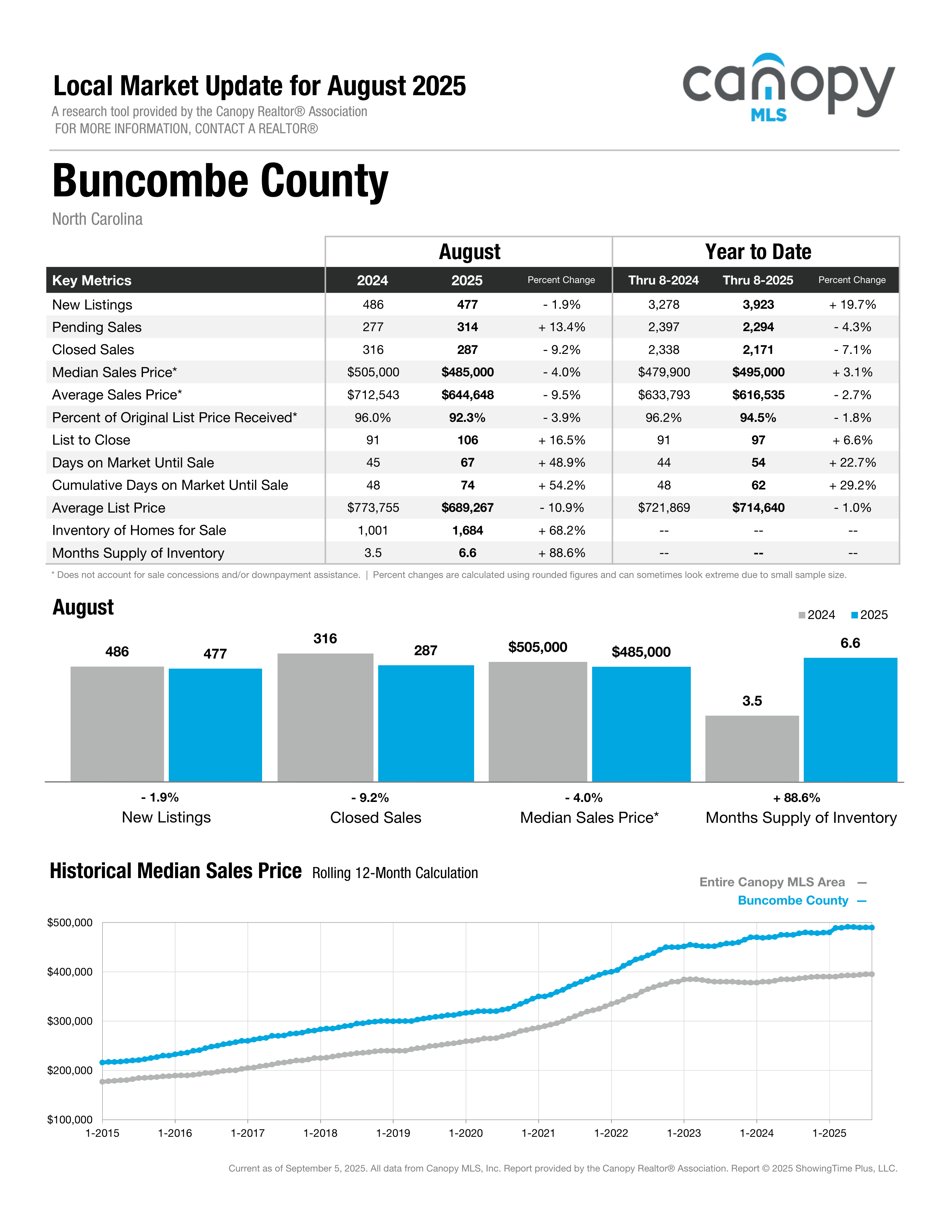
The Buncombe County housing market continued to shift in August 2025, showing a mix of opportunities for buyers and challenges for sellers. Let’s take a closer look at the latest numbers and what they mean for our local market.

New Listings & Inventory

  • New Listings dipped slightly, down 1.9% compared to last August (477 vs. 486).

  • However, year-to-date, new listings are up nearly 20%, giving buyers more choices than in recent years.

  • Inventory of Homes for Sale jumped 68.2% compared to last year, and the months supply of inventory rose from 3.5 to 6.6 months—a sign the market is moving toward more balance after years of tight supply.

Pending & Closed Sales

  • Pending Sales rose 13.4% year-over-year in August, showing stronger buyer activity compared to last summer.

  • Closed Sales, however, dropped 9.2% year-over-year and are down 7.1% year-to-date, pointing to some softening in overall transaction volume.

Home Prices

  • The Median Sales Price in August dipped 4.0% from last year ($485,000 vs. $505,000).

  • Year-to-date, though, prices remain up 3.1%, showing longer-term stability.

  • The Average Sales Price fell nearly 9.5% year-over-year, suggesting buyers are finding more options at lower price points.

Market Speed

  • Homes are taking longer to sell.

    • Days on Market increased 48.9%, averaging 67 days compared to 45 last year.

    • Cumulative Days on Market also jumped, up 54.2% to 74 days.

  • Sellers are receiving 92.3% of their original list price, down from 96.0% last August.

What This Means


  • For Buyers: Increased inventory and slower market pace create more room to negotiate and more options to choose from.

  • For Sellers: Pricing competitively is more important than ever, as buyers now have more leverage and patience in their home search.

  • For the Market Overall: After years of tight supply and fast-moving sales, Buncombe County is shifting into a more balanced market where both buyers and sellers need to adjust strategies.

Posted in Market Updates
Aug. 15, 2025

July 2025 Market Stats - Buncombe County

Buncombe County Real Estate Market Update – July 2025

Buncombe County’s housing market is showing signs of shifting this summer, with inventory climbing, prices still inching upward, and homes taking longer to sell. Here’s a breakdown of the latest trends from the Canopy Realtor® Association’s July 2025 report.

📈 More Homes Hitting the Market
New listings surged to 499 in July, a 25.7% jump compared to last year. Year-to-date, listings are up 23.3%, meaning buyers have significantly more options than they did in 2024. This growth in inventory is also reflected in the months’ supply, which doubled from 3.1 to 6.4—marking the shift toward a more balanced market.

🏡 Sales Activity: Mixed Signals
Pending sales rose 10.2% in July compared to last year, but year-to-date pending contracts are actually down 5.5%. Closed sales also saw a healthy 9.6% year-over-year increase for July, yet overall 2025 closings remain 7.2% lower than the same period in 2024.

💲 Prices Still Rising, But Growth Slowing
The median sales price climbed 7.5% year-over-year in July to $515,000, while the year-to-date median is up 4.2%. However, the average sales price dipped slightly (-0.8% in July, -1.4% year-to-date), signaling that while demand remains steady for well-priced homes, buyers are negotiating more aggressively.

⏳ Homes Taking Longer to Sell
The average days on market until sale jumped nearly 30% from last year, now sitting at 48 days for July. Cumulative days on market rose even higher—up 41% to 55 days—showing that sellers may need to be patient and strategic in pricing.

💡 What This Means for Buyers & Sellers

  • For buyers: With inventory up over 80% compared to last year, you have more choices and more negotiating power than we’ve seen in years.

  • For sellers: Homes are still selling, but pricing right is critical. Overpricing can lead to longer market times and more concessions at the closing table.


Overall, Buncombe County is moving toward a more balanced real estate market, giving both buyers and sellers opportunities—but also requiring realistic expectations on both sides.

Posted in Market Updates
Aug. 5, 2025

You Don’t Always Need 20%: What Down Payments Look Like Today ????

Many aspiring homeowners worry that they need a 20% down payment. In reality, that’s no longer the standard—especially for first-time buyers.

🎯 The New Norm: Around 9% Down, Not 20%

  • According to Realtor.com and the National Association of Realtors, the average down payment for first-time homebuyers is only 9% of the home price. That’s a far cry from the 20% rule of the past. Real Simple+5Realtor+5Realtor+5

  • For a median list price of $400,500 in early 2025, a 9% down payment comes to approximately $36,045—not the tens of thousands more many assume. New York Post

🏠 Why 20% Is No Longer Required

  • Many conventional loan programs now allow buyers to put down as little as 3% to 5%, especially for first-time buyers through programs offered by Fannie Mae and Freddie Mac. The Mortgage Reports

  • Government-backed loans such as FHA (3.5% down), VA (0% down for eligible veterans), and USDA (0% down in qualifying rural areas) make low—or even zero—down payment homeownership possible. The Mortgage Reports+1

💸 Sample Monthly Payments: What You Can Expect

  • With a roughly 9% down payment on that $400,500 home, a 30-year fixed mortgage at around 6.95% interest led to an estimated monthly payment of $2,413, excluding taxes and insurance. New York Post

  • By comparison, median monthly rent in late 2024 was about $1,695, making homeownership still more expensive but potentially more rewarding in equity-building. New York PostInvestopedia

🔎 Is Renting Forever the Only Option?

  • Gen Z—those born between 1997 and 2012—is currently saving more than any other generation, but they’re also facing high costs and low housing supply. That combination means many are renting longer or exploring alternatives. New York Post

  • Many young buyers are turning to creative solutions like co-buying, house hacking, or relocating to more affordable cities. New York Post

🧠 Breaking the Down Payment Myth

  • The idea that you must have 20% down before buying a home is outdated. There are a variety of paths—including low‑down or even zero‑down options—that make homeownership more accessible.

  • A smaller down payment may come with mortgage insurance (PMI), but it also enables you to preserve cash for emergencies or renovations. The Mortgage Reports+2Investopedia+2

📝 Final Thoughts


While putting down 20% can reduce loan costs and eliminate PMI, it’s not mandatory. Many buyers today tap into conventional programs with 3–10% down, or use FHA, VA, or USDA loans to sidestep traditional hurdles. The headline: if you’ve got 5–9% saved, homeownership might be closer than you think.


Read this article from Realtor.com for more information How much of a down payment do you need

Posted in Good to know info
July 11, 2025

June 2025 Market Stats - Buncombe County

Buncombe County Real Estate Market Update – June 2025: A Balanced Market is Emerging

The June 2025 housing stats are in, and the Buncombe County market is undergoing a notable shift. With a significant rise in inventory and a slight cooling in home prices, the area is beginning to show signs of moving toward a more balanced environment for buyers and sellers alike.

Inventory Rises Sharply, Creating More Options

One of the most striking changes in the market is the 77.9% increase in homes for sale compared to June 2024. Inventory nearly doubled from 893 to 1,589 active listings. This surge has pushed the months’ supply of inventory from 3.1 to 6.2 months—a 100% increase. In real estate terms, that’s a strong indicator of a market transitioning from a seller’s market to a more neutral or even buyer-friendly one.

Prices Show Mixed Signals

While the median sales price for June dropped 3.0% year-over-year (from $524,500 to $509,000), the year-to-date median tells a different story, rising from $475,000 in 2024 to $495,000 in 2025—a 4.2% increase. The average sales price dipped slightly both monthly and year-to-date, signaling some softening, particularly on higher-end properties.

Fewer Closings Despite More Listings

Despite the influx of new listings (up 11.0% in June and 22.7% year-to-date), closed sales dropped by 9.2% for the month and are down 10.4% for the year. Meanwhile, pending sales remain relatively flat, with a modest 2.2% increase in June but a 6.9% decrease year-to-date. These trends point to a more selective and cautious buyer pool, likely driven by interest rates and economic uncertainty.

Homes Taking Longer to Sell

The average days on market until sale increased by over 10% compared to last June and nearly 18% year-to-date. The cumulative days on market is up 24.5%, from 49 to 61 days. This confirms what many local agents are seeing on the ground: homes need to be priced right and show well to move quickly in today’s market.

Sellers Still Getting Close to List Price—but Not Quite

The percent of original list price received dropped from 96.9% to 95.2% in June, reflecting a softening in competition. Buyers have a bit more room to negotiate than in recent years.

What This Means for Buyers and Sellers

  • Buyers: With more inventory and more time to make decisions, this could be your opportunity to enter the market with greater leverage than before.

  • Sellers: It’s still a good time to sell, but pricing accurately and preparing your home for market are more important than ever. The days of multiple offers over asking price are fading—for now.


As always, local conditions can vary by neighborhood, price point, and property type. Reach out to a trusted real estate professional to help you navigate the current market with clarity and confidence.

Posted in Market Updates